
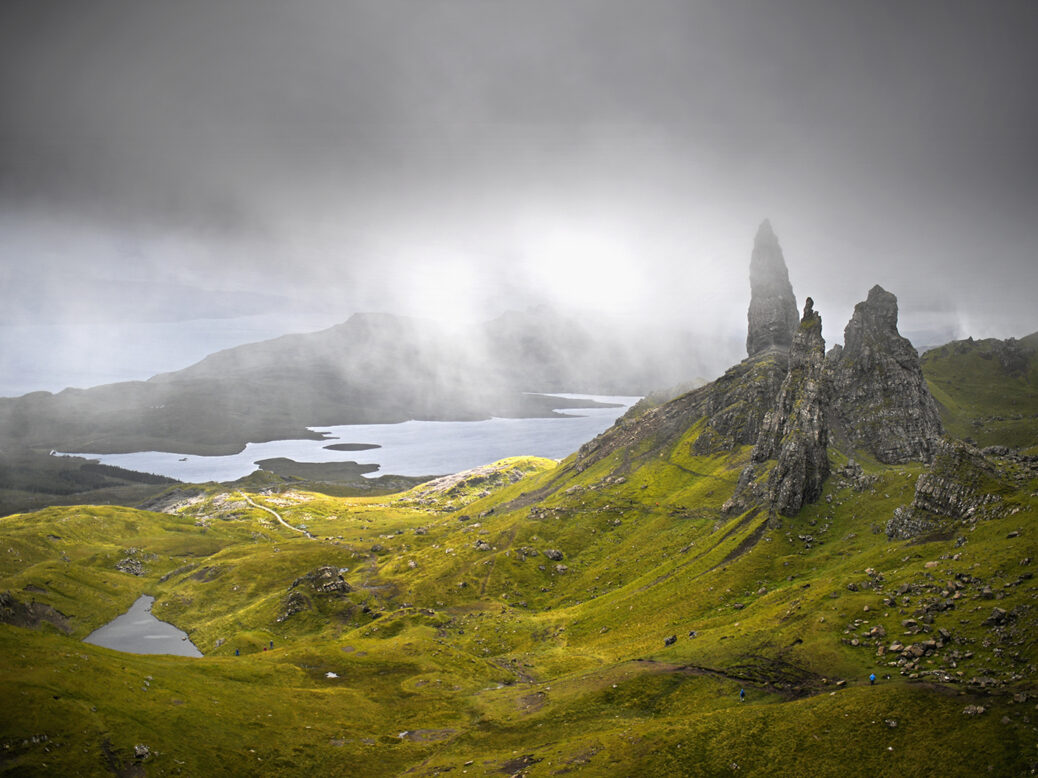
I’m writing this before the political storm, as it were, in the tranquillity of a West Highland “smirr” – which is, for those unacquainted with the Scots, a rain so fine you can barely see it, and yet surprisingly wet. I completely support the Prime Minister and I’m laser-focused on the job in hand.
But, friends, this is going to be a storm of the brownest and most pungent nature, is it not? It’s lonely being a natural optimist, but that is a matter of temperament and fate, not choice. So here goes… We thirst for a government with a clear purpose and philosophy, one that thinks more radically about growth and about defending ourselves. And in the coming fight for the leadership, every candidate is at least talking this way, trying to focus on the big stuff. One candidate, it seems, is an outsider called Keir Starmer, who wrote on 2 May about the “perfect storm of crises sweeping towards us”.
He called for “a national mission to become a stronger, more resilient, and more united nation, allowing us to take control of our future, raise our sights, and reach towards something better”. In Wes, Andy, Angela and others, Labour has some remarkable and talented people. But whoever is in Downing Street later this summer, more of this please.
Words, words, words! But even from the vantage point of a croft looking out at mountain ranges and islands, where the pine martens are more of an immediate threat than populists, this feels like a moment of great fragility. It would be odd to keep calling for a government of national resilience and then sneer or turn away when it’s offered.

And now there is a gleam of sunlight on the hill. The temperature has risen to 8°C. And I am off for a swim.
The Kennedy curse
The constituency I’m staying in was once represented by the brilliant Charles Kennedy, the former Lib Dem leader who died at 55. Nobody was better company than Charlie but alcohol was part of that story and, like many Highlanders, he struggled with it all his life. After I had threatened to report his problem, we fell out. A make-up dinner was arranged. “Look, Andrew,” he said to me proudly when I arrived, “I’m having a mere half glass of white wine. You wouldn’t call that drinking.” This was true. It was also true that he went on to have a mere half glass about two dozen more times while I apologised for my outrageous journalism.
Commons drinking is in the public eye at the moment after a complaint about it by the new Green MP Hannah Spencer, and because of reports about Angela Rayner being well away. Two thoughts. First, being an MP can be lonely, high pressure and utterly destructive of ordinary life. Second, though the drinking culture is declining, it still requires great self-control to survive it. I had a dear colleague who was always five minutes before me into the press bar and late to leave. He died on the streets of Glasgow, having lost everything.
The Highland way
This is partly, perhaps, why I gave up alcohol a couple of years ago. I will go back as soon as I stop broadcasting regularly because it’s also one of life’s great pleasures. I’ll start with a good malt whisky – an Islay, probably. Its production keeps swathes of the Highlands alive. Donald Trump and King Charles are widely applauded here for the US decision to remove all tariffs and restrictions on whisky imports: if Charles’s Washington visit achieved nothing else, it was worth it for this.
Patriot games
The hills and mountains I look out upon – the wilderness known as Assynt – are strongly associated with the poet Norman MacCaig. He was part of the group of leftists and Scottish nationalists who have dominated Edinburgh literature in the past century, but his attitude to nationalism was always quirky. One short poem goes like this: “My only country/Is six feet high/And whether I love it or not/I’ll die/For its independence.” Not a bad motto for life.
Portrait of an artist
The new exhibition of Francisco de Zurbarán at the National Gallery is a visual reminder of the angry, passionate power of the Catholic Counter-Reformation, a part of the European story barely remembered in Britain. When I was growing up, Catholic migrants to Scotland experienced hostility that wasn’t so different to that faced by Muslims in the UK today.
I have been rereading Richard Ellmann’s biography of James Joyce, who had a deeply complex relationship with Catholicism and the Jesuits. But he had the most undermining wit. Ellmann tells of a young admirer coming up to Joyce in Zürich and asking: “May I kiss the hand that wrote Ulysses?” Joyce, after a momentary hesitation: “No. It did lots of other things too.”
[Further reading: Weimar from Goethe to Hitler]
Content from our partners


Related
This article appears in the 06 May 2026 issue of the New Statesman, Tis but a scratch
Join the debate
Subscribe here to comment